- Leading Provider Of Industrial Solutions
- Certified ISO 9001:2009

- Leading Provider Of Industrial Solutions
- Certified ISO 9001:2009
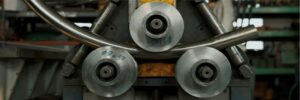
Three-roller bending technology, operated by manual or hydraulic systems, is one of the most widely used bending methods in the industry. It is suitable for bending a wide range of materials, including pipes, profiles, flat bars, angles, shaped sections, and even solid materials.
This technology is particularly effective for large-radius bending applications. It is also one of the few methods capable of forming large-diameter pipes (such as 300, 400, or 500 mm Ø) without the need for additional heating. As a result, it is commonly used in applications ranging from small components to large-scale structures such as steel constructions and pipelines.
In this method, the pipe or profile is fed between three rollers:
Two rollers are positioned at the bottom (usually driven)
One roller is positioned at the top (adjustable)
The bending radius is created by the vertical movement of the top roller:
When the top roller moves downward, it approaches the lower rollers, increasing deformation and resulting in a smaller (tighter) radius
When the top roller moves upward, the pressure decreases, resulting in a larger radius
The rollers rotate to feed the material through the machine. Depending on the machine design, either two or all three rollers may be driven to facilitate smooth material movement.
Unlike rotary draw bending, this method does not apply a concentrated twisting force. Instead, bending is achieved through progressive deformation over multiple passes.
The achievable bending radius depends on:
*Machine capacity
*Roller diameter
*Roller positioning and stroke
Typically, this method is used for large-radius bending, where deformation is gradual and distributed along the material. In some systems, a fourth roller may be added to improve control and pre-bending capability. However, the fundamental bending principle remains the same. Manual and hydraulic machines are widely used, but CNC-controlled systems are preferred for applications requiring higher precision and repeatability, as manual feeding control can be challenging.
Advantages
*Cost-effective solution
*Ability to produce multiple radii with a limited number of roll sets
*Highly suitable for large-radius applications
*Capable of bending a wide range of material types and sizes
Disadvantages
*Not suitable for small (tight) radii
*Difficulty in maintaining consistent radius along a single workpiece
*Challenging control of pitch and spacing in multi-bend (spiral or segmented) applications
*Requires operator experience for accurate results in manual systems